Mostly good news on this topic. I talked to Blair Patrick earlier today about the problems I was having, and he suggested that I should be looking at the valve to stem clearance on the exhaust valves. He thought that there was at least a small chance that the valves were seizing in the guides, and that was contributing to the excessive wear or possibly even the seizing of the rockers on the shafts. Tonight I pulled one of the heads apart, and found that the valves all had plenty of clearance. I don't have the tool to measure it exactly, but I spoke with my machinist at R&R Performance, and he said they set all the exhausts to 1.8 thousandths clearance, and all the intakes to 1.6 thousandths. He also said that in 15 years they've never had a valve seize in a guide. Based on this and the way the valves felt in the guides, I think I can rule out this possibility.
Then Larry from T&D called me tonight, and we had a very interesting conversation. First, Larry made it clear from the outset that he would stand behind his products. I had suspected that he would do that, because I've always heard good things about T&D, and have had good experience with their wedge rocker setups. But it was nice to hear it directly from Larry anyway.
Next we started discussing the adjusters, and Larry told me that the engineers at T&D had finally succeeded in duplicating the failures I was seeing! I was really relieved to hear that, as I was beginning to feel like the boy who cried wolf. Larry said that their initial testing showed that the adjusters were good up to a torque of around 45 ft-lbs. They had no failures below that torque level, after several different types of testing. Then, however, they tried a test where they put a load on the elephant foot adjuster, to duplicate the load from the valve spring. After applying that load, they removed it and torqued the lock nut to 30 foot pounds, and began to see the same kind of failures with the adjuster breaking that I had experienced.
So, T&D will be making up new sets of adjusters for these rocker arms, using a different material that is more ductile, and replacing the adjusters in all the sets of rockers.
Next we talked about the fit of the rockers on the shafts, and Larry pointed out that all of T&D's rockers are based around needle bearing fulcrums, and that they hadn't done a sleeve type bushing in a rocker setup for 25 years. He said they had aimed for a clearance of around .001", but based on my results thought it might be too tight. After some discussion I suggested that he measure the ID of some of the factory SOHC rockers that he had available at his place, and just try to duplicate those clearances. I think he's going to go ahead with that, and I'm guessing he'll end up at .0015" to .002" of clearance, which should be fine based on my experiences with the Dove and RAS rockers. Larry said he can hone the existing rocker bores up to the larger clearances, so remaking the rockers won't be necessary.
Finally we discussed the grooves that were cut into the rocker shafts by the spring clips. Larry thought that this was probably a shaft hardness issue; he hadn't hardened the shafts as much as he normally would with a needle bearing fulcrum assembly. The reason was that at the lower hardness level, if the rocker shafts were bent a little from spring pressure during installation or removal, they would tolerate that stress without cracking. Of course if the SOHC shafts are installed and removed correctly no stress is put on the shafts, but I'll confess to screwing this up once or twice and putting a spring load on the shafts inadvertently. So this was a durability consideration, because a harder shaft could crack under these conditions. In any case, though, this consideration is trumped by the grooving caused by the very hard spring clips, so Larry is going to increase the hardness of the shafts so that this problem is eliminated.
It sounds like T&D is already working on getting these problems solved, with new rocker shafts and adjusters in process. I have to send my parts back to T&D to get revamped, and this will probably take several weeks, but I'm pleased that they recognize the issues and are taking quick corrective actions. I believe they will also be recalling the other SOHC rocker sets that have been sold, to modify those also.
By the time the rockers are ready, I hope to have one or both of my SOHC engines back together, so I can continue the testing. My thanks to the forum for all the excellent comments and suggestions I received on this topic, and of course to T&D for standing behind their products.
Jay Brown
1968 Shelby GT 500 Convertible, 492" 667 HP FE
1969 R code Mach 1, 490" supercharged FE, 9.35 @ 151.20, 2007 Drag Week Runner Up, Power Adder Big Block
2005 Ford GT, 2006 Drag Week Winner, 12.0 Daily Driver
1969 Ford Galaxie XL, 460 (Ho Hum....)
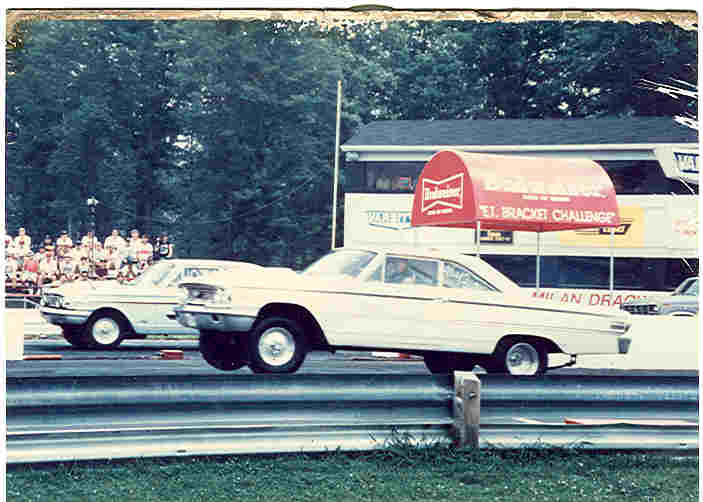
1964 Ford Galaxie 500, 510" SOHC
![[linked image]](../../../../../Realm/JaysPictures/wheely10.JPG)
![[linked image]](../../../../../Realm/JaysPictures/jaktsm.JPG)
![[linked image]](../../../../../Realm/JaysPictures/smplaq.JPG)


![[linked image]](../../../../../../forums.pcpitstop.com/style_emoticons/New_emoticons/dead-horse-fast2.gif)
![[linked image]](../../../../../../pic20.picturetrail.com/VOL75/2176019/4241235/61364598.jpg)
![[linked image]](../../../../../../pic20.picturetrail.com/VOL75/2176019/4241235/61364557.jpg)

![[linked image]](../../../../../../i58.photobucket.com/albums/g258/OHUQTU/MM4RD.jpg)